

Quartz vs quartzite might sound like a tongue twister, but the real mix-up happens when you assume they’re the same countertop material.
Sure, both share the mineral quartz in their makeup, yet one is nature’s creation and the other is engineered. Understanding what sets quartz countertops apart from quartzite countertops is the first step in choosing the surface that supports the way you live.
By the end of this article, you should be clear on the pros and cons of each material and which one might be perfect for your home.
Quartzite at a Glance: Nature’s Heat-and-Pressure Creation
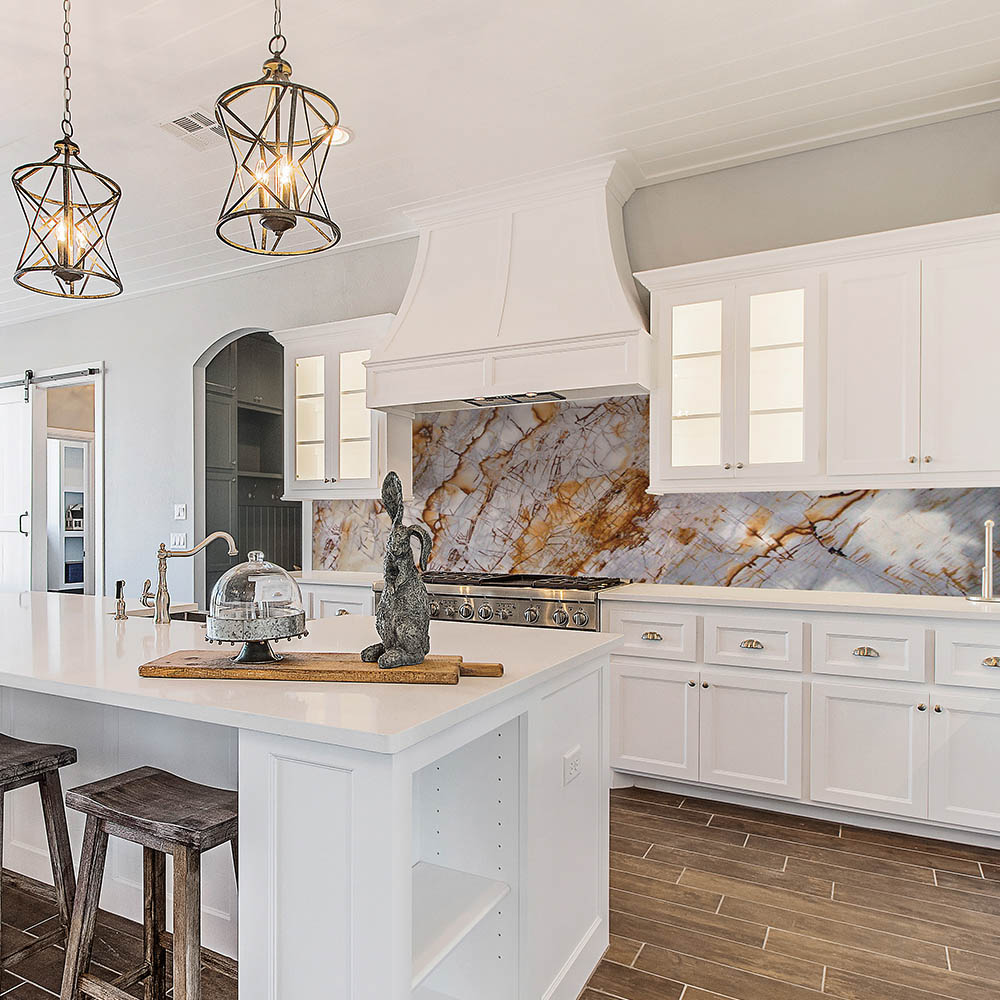
Quartzite is a metamorphic rock, formed when sandstone is buried deep within the Earth and subjected to extreme heat and pressure. Over millions of years, the quartz mineral inside the sandstone fuses into an interlocking network of crystals to create a dense, durable stone with a glassy hardness that often exceeds granite on the Mohs scale.
Each quartzite slab is distinct. The natural veining and subtle color shifts cannot be manufactured. This individuality is why designers often choose quartzite for statement kitchen islands or focal-point countertops.
Later, we’ll look at how this impressive toughness compares with quartz when it comes to resisting stains, scratches, and everyday wear.
Quartz at a Glance: Engineering Beauty from Quartz Crystals

Quartz countertops are an engineered stone, plain and simple. They’re created by combining crushed quartz crystals (yes, the same quartz) with resin and color pigments. The manufacturing process involves compressing the mixture into dense, non-porous quartz slabs that are then polished to a consistent finish.
Because quartz is man-made, manufacturers can create designs that mimic marble, granite, or even quartzite while maintaining a predictable appearance across the entire surface. So, the colors, patterns, and veinings are more uniform. You can almost literally copy and paste the exact same quartz design into several homes (something you can’t get with natural stones like quartzite).
This controlled production also influences how quartz responds to spills, heat, and day-to-day use, which we’ll examine more closely when we compare maintenance and longevity.
Key Differences Between Quartz and Quartzite Countertops
By now, we know quartzite comes from the earth, and quartz comes from the factory floor. But the differences don’t stop there. Here’s how the two materials compare in the real world:
- Origin – Quartzite is a natural stone, shaped over millions of years by heat and pressure. Quartz is engineered by combining crushed natural quartz crystals with resin and pigments to create uniform slabs.
- Appearance – A slab of quartzite is one of a kind, with veining and color variations formed by nature. Quartz can imitate natural stones like marble or granite, but its look stays consistent from one slab to the next.
- Hardness – Quartzite is harder than quartz, ranking just below diamonds among countertop minerals. Quartz is still durable, but its resin content makes it slightly softer.
- Porosity – Natural stones like quartzite are porous and need periodic sealing to help guard against stains. Quartz is non-porous, so it resists most liquids without extra treatment.
- Seams & Slabs – Because each quartzite slab is unique, large kitchens often require multiple pieces, and matching veining perfectly can be a challenge. Quartz allows for near-identical slab matching, which can mean cleaner seam lines.
These distinctions aren’t just academic. In the next section, we’ll see how they influence the kind of everyday durability, stain resistance, and upkeep each material demands.
Quartzite Vs. Quartz Countertops: Durability and Maintenance Comparison

When it comes to resisting daily wear, quartzite and quartz take different approaches.
- Scratch resistance – Quartzite is extremely hard, which makes it difficult to scratch, but it can still etch if acidic foods or cleaners sit on the surface too long. Quartz, while not quite as hard, resists most scratches you’ll encounter in a busy kitchen.
This difference goes back to what we covered in hardness: quartzite’s strength comes from nature, while quartz’s durability comes from its engineered structure. - Stain resistance – Quartzite is porous and requires sealing to help prevent stains. Without it, oils, wine, or coffee can seep in and leave a mark. Quartz is non-porous, so liquids bead on the surface, making cleanup easier.
Both materials can hold their beauty for decades, but their care routines shape how they age. In natural stones like quartzite, stains or etching can soften the crisp look of the veining over time.
With quartz, its uniform surface tends to keep the same appearance year after year. In the next section, we’ll see how these differences in durability and upkeep influence the cost and value of each option.
Cost: What to Expect Per Square Foot
When people ask which one costs more between quartz and quartzite, the honest answer is, “It depends.” Both have a high and low end, and the difference often comes down to the specific slab you choose.
In quartzite, rarity of color, how far it traveled, and the difficulty of fabrication all influence the final number. With quartz, the pattern, finish, and brand can push the price just as much as the material itself.
Quartzite is often on the higher side because it’s a natural stone that requires skilled cutting and finishing. But as we saw in durability, that extra investment can make sense for a surface that’s built to last.
High-quality quartz offers its own version of long-term value, especially if you prefer less maintenance without giving up style. Ultimately, cost is only part of the decision — the right choice balances budget with how you live and use your space.
Style and Design Considerations
Quartzite and quartz each bring a distinct personality to a space. Let’s break it down:
Where they shine
- Quartzite: Perfect for statement kitchen islands, dramatic bathroom vanities, or anywhere you want a “one-of-a-kind” look. The natural veining is nature’s artwork.
- Quartz: Best for modern, minimal, or uniform spaces. Its engineered surface delivers consistent color and pattern, making it easier to match across multiple slabs.
The design feel
- Quartzite gives you a natural material with personality. No two slabs are ever the same.
- Quartz offers a controlled, repeatable look, from marble-like swirls to bold solid tones.
Next, we’ll put these style and performance details into a side-by-side view so you can see the full picture before choosing.
Choosing Between Quartz and Quartzite: Which is Right for You?
The best choice isn’t about which material is “better.” It’s about which one fits your life, your space, and your priorities.
Think about your lifestyle
- Busy family or heavy-use kitchen: Quartz offers consistent durability with minimal upkeep.
- Design-forward space: Quartzite brings unique patterns and natural drama that make a statement.
Maintenance comfort level
- Low-maintenance preference: Quartz needs little more than regular cleaning.
- Willing to care for natural stone: Quartzite rewards sealing and mindful use with unmatched beauty.
- Budget balance: Both have a range from practical to premium. Your final cost depends on the specific slab and project details.
The look you want
- Quartzite: No two pieces are alike.
- Quartz: Predictable, controlled design.
Before making the call, talk with a countertop specialist from Cutting Edge Countertops, who can walk you through options and show you slabs in person. Seeing the real material — not just a photo — often makes the decision clear.
Conclusion and Next Steps
When you strip it down, the difference between the two is simple. Quartzite is nature’s masterpiece — shaped by heat, pressure, and time into a surface with one-of-a-kind veining and unmatched strength. Quartz is a crafted solution — engineered for consistency, color control, and easy care.
Both can elevate a kitchen, bathroom, or any space where beauty meets function. The right choice depends on how you live, the style you love, and how much day-to-day maintenance you want to take on.
Pictures can’t fully capture the depth, texture, and color of a real slab. Visit any Cutting Edge Countertops showroom near you to see them in person, run your hand over the surface, and find the piece that feels right for your home.
Quartz vs Quartzite FAQs
Is quartzite harder than granite or quartz?
Yes. Quartzite is harder than granite and quite a bit harder than quartz, ranking just below diamonds on the Mohs hardness scale. Quartz is still a durable surface, but it is not quite as hard as quartzite.
Which is easier to maintain, quartz or quartzite?
Quartz countertop surfaces are extremely low-maintenance because they are non-porous and resist stains without sealing. Quartzite requires sealing to help protect against spills and etching, and you’ll need to clean quartzite countertops with pH-balanced cleaners to maintain the surface.
Which lasts longer, quartz or quartzite?
Both quartz and quartzite countertop surfaces are long-lasting, but quartzite is a natural stone and can last for decades with proper care. Quartz is an engineered product that’s extremely durable, but it is not harder than quartzite.
Can quartzite stain or scratch?
Yes. Quartzite counters can stain, and acidic foods can etch the surface. They are resistant to scratching, but no surface is completely scratch-proof. Quartz resists most everyday scratches but is softer than quartzite.
Are quartz countertops made from real stone?
Quartz kitchen countertops are engineered using crushed quartz crystals with resin and pigments. Unlike quartzite, which is natural, quartz is manufactured to offer specific colors, patterns, and features.
Does quartz look like granite or marble?
Yes. Quartz can be manufactured to mimic the appearance of natural stones like granite or marble, giving you the look of stone with a more uniform, low-maintenance surface.
Which is better for a busy family kitchen: quartz or quartzite?
For busy kitchens, engineered quartz countertops are often the best fit because they require less maintenance and resist most stains. Quartzite also works well if you’re committed to caring for natural stone.
Does quartzite require sealing?
Yes. Quartzite requires periodic sealing to help reduce staining and make the surface easier to maintain. This is one of the main differences between quartz and quartzite.
Can quartzite also be used in bathrooms?
Absolutely. Quartzite is a natural stone, so it brings unique veining and durability to bathroom vanities, showers, and other areas. Quartz countertops come in a wide variety of colors and also work well in bathrooms.
Is quartz as heat-resistant as quartzite?
No. Quartz is one of the most durable countertop materials, but the resins used in engineered quartz countertops can be damaged by high heat. Quartzite is far more heat-resistant.