

What does “engineered quartz” actually mean? How is a quartz countertop made, and what’s inside it? Why does the slab look so seamless and uniform? Does the manufacturing process affect how stain-resistant or durable it really is?
At Cutting Edge Countertops, we’ve worked with natural quartz, resins, and advanced slab technology since 2006, fabricating up to 60 custom projects per day. In this blog, we’re breaking down the full process, so you can shop smarter, with confidence and clarity.
From Earth to Engineered: How Quartz Countertops Are Made
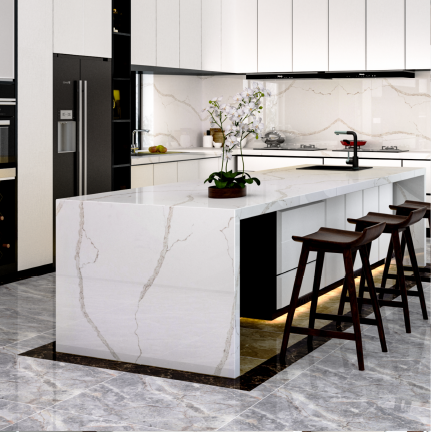
Here’s what really happens before a quartz countertop reaches your home, from raw quartz extraction to perfectly polished, ready-to-fabricate slabs.
1. It Starts with the Stone: What Is Quartz, Really?
Quartz countertops begin with quartz itself, a mineral found in nearly every part of the world. It’s hard, durable, and naturally abundant. But here’s the key distinction: while granite or marble slabs are cut straight from quarries, quartz countertops are man-made. They start as crushed natural quartz crystals, combined with pigments and resins to form a new, engineered surface.
If you’re weighing quartz against other natural options, it helps to compare quartz vs granite or quartz vs marble to see how the differences in sourcing and performance stack up.
Why that matters: Engineered quartz offers consistency. The color, pattern, and finish are controlled during production, eliminating the guesswork common with natural stone. The result? A non-porous, low-maintenance surface built to perform in real kitchens, not just showrooms.
2. Crushing, Blending & Mixing: Where Raw Materials Meet Engineering
Once raw natural quartz is extracted, it’s crushed into a fine, uniform grit. The goal isn’t just to pulverize, it’s to create a consistent base that blends cleanly with resins and pigments. These added components give the slab its strength, color, and durability.
Different blends may include UV stabilizers, stain-resistant additives, or antimicrobial agents. These aren’t afterthoughts; they’re engineered into the slab from the start.
How does a quartz countertop resist wear, scratches, and discoloration? It begins in this mixing stage. Uniformity here means fewer seams, better performance, and a smoother finish later.
3. Molded Under Pressure: Forming Quartz into Slabs
The blended mix is poured into molds, typically the size of standard countertops. But simply pouring isn’t enough. A combination of vacuum and vibration removes trapped air, preventing structural weak points. Then, the real pressure begins, literally.
The material is compacted under tons of force, aligning every particle to create a dense, solid form. This is what gives quartz slabs their signature strength.
It’s also why they’re non-porous; no tiny holes for stains or bacteria to slip into. And because the slabs are cast rather than cut, they offer greater design uniformity with fewer natural flaws.
4. Heat, Cure, and Polish: Finishing the Quartz Slab
Once compacted, the slab enters a curing phase, where it’s slowly heated (usually around 85°C) to solidify the structure. This heat activates the polymer resins, hardening the slab into a finished surface. At this point, the slab’s structure is locked in, resistant to stains, scratches, and impacts.
After cooling, the slab is calibrated to an exact thickness, then polished using industrial-grade equipment. Whether high-gloss or matte, the finish is built to last. No sealing required. It’s during this step that the durability, cleanability, and aesthetic value of engineered quartz become visible, making it ready to stand up to real life.
5. Ready for Fabrication
With the quartz slab complete, it’s now sent to expert fabricators, like our team at Cutting Edge Countertops. This is where the slab gets transformed into a finished countertop: cut to size, edged, and fitted with sink cutouts, overhangs, and seams.
The precision of the earlier stages makes this part easier and cleaner. A well-made slab doesn’t just look better; it fabricates better. A sink cutout, for example, is a chance to elevate design, something you can learn about in our guide to top kitchen sink trends and styles.
That means tighter seams, better polish, and a faster path to installation. What happens next (template, cut, polish, install) belongs to the fabrication and installation team. But it all starts here, with a well-engineered slab.
Why the Manufacturing Process Matters to You

The way quartz countertops are made isn’t just technical. It directly impacts how they look, perform, and last in your home.
Consistency Means Fewer Surprises in Your Kitchen
When you choose engineered quartz, what you see is what you get. Unlike natural stone, where slabs can vary widely in color and veining, man-made quartz is manufactured for consistency. Every quartz slab is uniform in pattern and tone, making it ideal for large layouts, multiple surfaces, or rooms where alignment matters.
Curious about what’s trending this year? Check out our round-up of popular countertop colors to see the palettes designers are pairing with quartz right now.
This means fewer mismatched seams, no unexpected color shifts, and a smoother design process. It’s one of the biggest advantages of high-quality quartz: predictability without sacrificing visual interest.
Strength You Can Count On
Quartz countertops aren’t just good-looking; they’re built to handle real life. During the manufacturing process, quartz is crushed, blended with resins, and then cured into a solid surface that’s dense, durable, and long-lasting.
The result? Fewer chips, fewer cracks, and reliable scratch resistance. Because quartz is non-porous, you also don’t have to seal it like you would with granite or marble. That built-in resistance to stains, from wine, oils, coffee, and more, makes it a smart choice for kitchens that actually get used.
For maintenance tips, see our guide on spring kitchen cleaning for spotless sinks and countertops.
Clean Lines, Cleaner Surfaces
Precision manufacturing leads to tight seams, clean cuts, and a polished surface that’s both practical and visually refined. While all countertops have seams, how well they line up and how little they disrupt the surface’s flow depends on the quality of the slab and the fabricator’s skill.
Quartz’s uniformity makes it easier to cut and align, especially around complex areas like sink cutouts or corners. And because the surface is non-porous, it’s easier to clean and less likely to trap bacteria—perfect for home chefs and busy families.
Design That Reflects You
The beauty of handcrafted quartz is that it doesn’t limit your design vision—it expands it. Whether you want bold movement, subtle veining, or soft neutral tones, quartz can deliver a range of unique colors and styles that are tough to replicate in natural stone.
From ultra-modern to rustic farmhouse, quartz fits in without forcing a compromise. And because the color and pattern are engineered into the slab, you don’t have to worry about running short or mismatching surfaces across your kitchen or bath.
If you’re still in research mode, our Countertops 101 guide breaks down the pros and cons of different surface materials, so you can choose confidently.
Ready to Choose the Right Quartz Countertop?
The manufacturing process matters, but so does where you get your slab. At Cutting Edge Countertops, we offer exclusive, top-tier quartz options designed for real homes and real life. From material selection to fabrication, we’re here to help you make the right choice with confidence.
- Browse our Edge Collection for premium quartz colors and styles
- Visit a showroom near you to see slabs in person and talk design
- Work with a Project Coordinator who’ll walk you through every step
High-quality quartz. Expert guidance. No guesswork.
FAQs
Are quartz countertops natural or man-made?
Quartz countertops are man-made using crushed natural quartz mixed with resins and pigments. This engineered process creates consistent, durable slabs—unlike natural stone, which varies from block to block.
What makes quartz countertops durable?
Quartz slabs are compacted under pressure and cured with heat, creating a dense, non-porous surface that resists stains, scratches, and daily wear—making them a long-lasting option for busy homes.
Do quartz countertops need to be sealed?
No. Quartz is non-porous, so it doesn’t need sealing like granite or marble. That built-in barrier makes it easier to clean and more resistant to stains, bacteria, and moisture.
What colors are available in quartz?
Quartz comes in a wide range of styles—white, marble-look, bold tones, or soft neutrals. The engineered design allows for consistent veining and color across slabs, ideal for cohesive spaces.