

New countertops can increase your home’s value, but not automatically and not by a fixed amount. The honest answer sits between a marketing myth and a smart move: material matters less than condition, timing and fit for your home’s price range.
If you’re weighing a countertop update before a future sale, the real question isn’t which stone costs the most. It’s which surface removes buyer doubts without asking you to overspend. Here’s how to think through timing, materials and installation so the investment actually pays off.
Start With the Question the Earlier Guide Did Not Answer
As we explained in our earlier guide, quartz and granite remain dependable starting points when you’re choosing a countertop for resale. That article walks through the material comparison in detail, so we won’t repeat it here.
This piece answers a different question. Material choice is only one input. Timing, existing condition, your home’s price tier and how well the project gets installed all shape whether a countertop update actually helps you sell. A homeowner who picks the “right” material but installs it poorly can spend money without moving the needle on buyer appeal. The same goes for replacing a countertop that didn’t need replacing.
If you haven’t compared materials yet, start with our earlier guide to countertop materials for resale. Then come back here to figure out whether, when and how much to invest.
When Do New Countertops Actually Help Resale?
New countertops help most when they remove a reason for a buyer to hesitate. Dated laminate, chipped edges, deep stains or heavy scratching all signal deferred maintenance. Buyers notice, and they often mentally subtract more than the repair would actually cost.
Replacement tends to help when:
The counters show visible damage: Cracks, burn marks or worn finishes make a kitchen look older than the rest of the home.
The style clashes with an updated space: If you’ve already renovated cabinets or flooring, an outdated countertop can drag down the whole room’s perceived value.
The layout limits usable space: Cramped or awkward counter space is a common buyer objection that a well-planned new surface can solve.
The kitchen is a first impression driver: In most homes, the kitchen carries outsized weight in a buyer’s overall impression, so problems there tend to stand out.
Replacement is less likely to help when the existing countertop is in solid condition, matches the home’s price point and simply isn’t your personal taste. A countertop that works but doesn’t excite you may be a candidate to leave alone, especially if you’re not planning to sell soon. Buyer appeal and personal preference are not the same thing, and it’s worth separating them before you commit to a project.
Which Materials Have the Broadest Buyer Appeal?
No single material is the universal resale winner. Each one carries tradeoffs in appearance, upkeep and cost. The right choice depends on your home, your budget and how buyers in your market tend to shop, including where you land on natural stone and engineered surface tradeoffs. Here’s how the main options compare.
Quartz for Consistency and Easier Day-to-Day Care
Quartz is often a smart fit for sellers who want broad appeal without much explanation. It offers a consistent look from slab to slab, doesn’t require sealing and holds up well to everyday kitchen use. Buyers touring a home tend to read consistent quartz as low-risk and move-in ready. The main caution is heat. Quartz resins can start to break down under sustained heat above roughly 300 degrees, so hot pans still need a trivet.
Granite for Recognizable Natural-Stone Value
Granite carries a strong reputation with buyers who specifically want natural stone. Its heat tolerance is excellent, and its natural variation gives a kitchen a distinct character that engineered surfaces don’t replicate. Granite does need sealing roughly every one to two years to reduce the risk of staining, and the exact slab you choose matters. Pattern and color vary widely, so seeing the actual slab before fabrication matters more with granite than with a more uniform material.
Quartzite for Natural Movement and Strong Performance
Quartzite draws buyers who want the dramatic veining associated with marble but with tougher day-to-day performance. It’s a genuine natural stone, so it needs sealing and the same slab-selection care as granite. Slab-to-slab variability can be significant, and true quartzite is sometimes confused with softer “soft quartzite” or dolomitic stone that behaves differently. For a home in a higher price tier, quartzite can be a strong fit precisely because it signals a premium, hand-selected material.
Marble for the Right Home and the Right Buyer
Marble has undeniable visual appeal. In the right home, it photographs beautifully and draws attention during a showing. It’s also the material most likely to etch from acidic spills like lemon juice or wine, and that reality doesn’t disappear with sealing. Marble tends to work best on an accent surface, like an island, or in homes where buyers already expect a higher level of natural stone maintenance. It is not usually the safest universal resale choice for a broad buyer pool.
Compact Surfaces for Performance-Driven Modern Homes
Compact surfaces appeal to buyers drawn to a clean, contemporary look paired with strong scratch, heat and stain resistance. They handle daily wear well, which can be a selling point for buyers who specifically ask about durability. No surface is truly indestructible, so normal care still applies. Even so, compact surfaces are a reasonable option for homes with a modern design language where buyers expect low-fuss performance.
Choose for Your Selling Timeline
Your selling timeline changes the calculation more than any single material spec. Think through which of these three scenarios describes you.
Selling within the next several months: Prioritize condition over customization. Focus on removing visible objections, like damage or a clearly dated look, with a material and color that suits your home’s price tier. This isn’t the moment for a highly personal or unusual choice.
Selling in a few years: You can choose a countertop you’ll genuinely enjoy living with. Stay within a reasonable range of neutral, broadly appealing colors and patterns, and you get years of use out of the investment before resale even becomes a factor.
No firm sale date: Choose based on how you use your kitchen and what fits your budget and lifestyle now. A countertop that serves your household well for a decade delivers value whether or not you eventually sell. Resale considerations matter less the further out your timeline sits.
Matching the decision to your actual timeline keeps you from overspending on a rush project or underinvesting in a surface you’ll live with for years.
Match Maintenance Expectations to Future Buyers
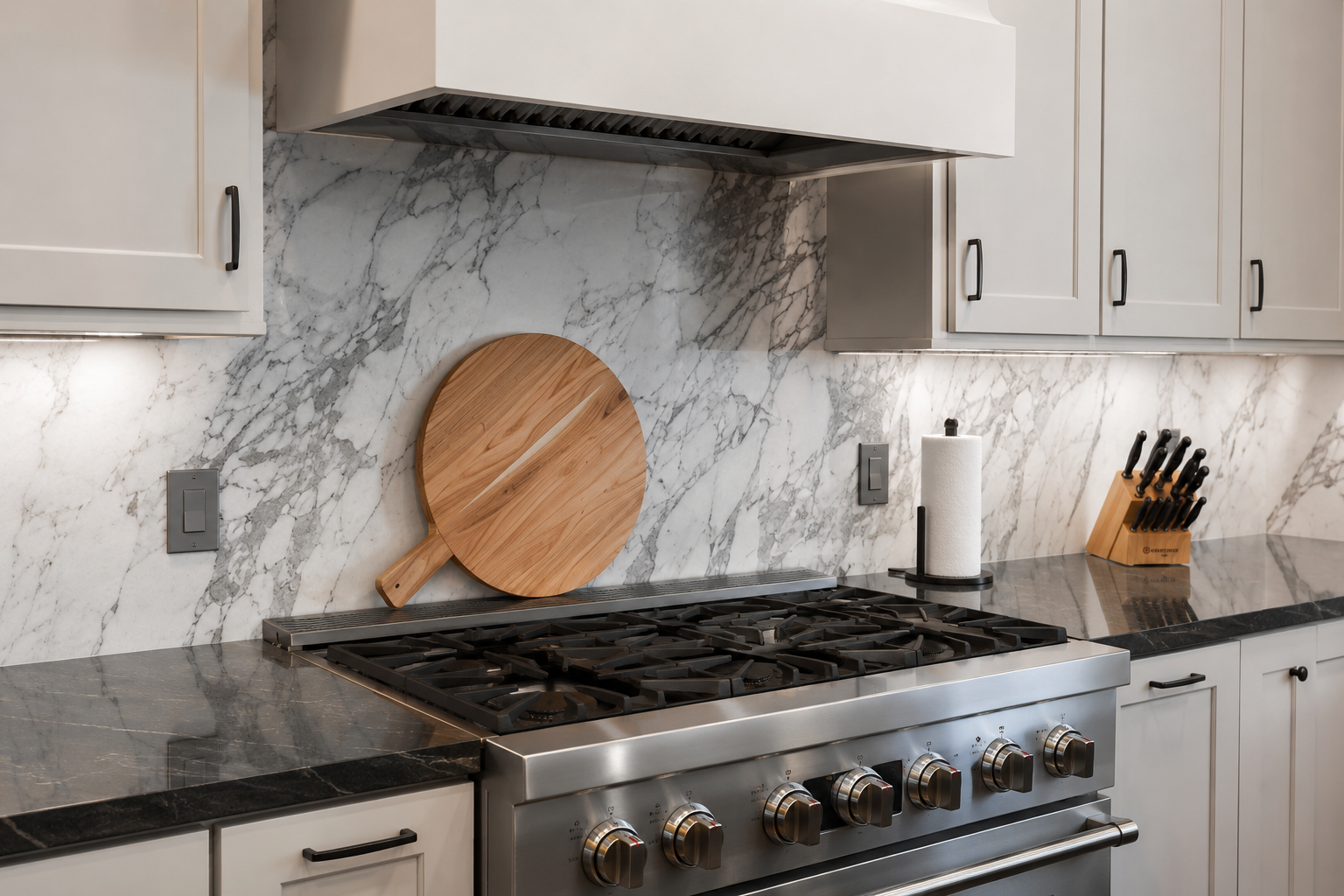
Maintenance expectations shape buyer perception as much as looks do. A buyer who sees a natural stone countertop may ask about sealing, staining risk and upkeep, especially if they’re less familiar with stone ownership. A buyer touring a home with quartz or a compact surface typically has fewer maintenance questions to work through.
Neither answer is automatically better. It depends on who is likely to buy your home. A move-up buyer in a higher price tier may expect natural stone and view the upkeep as part of the package. A buyer prioritizing convenience may respond better to a lower-maintenance surface. If you’re unsure how to weigh that tradeoff, our low-maintenance countertop options guide breaks down which surfaces ask the least of a new owner.
Avoid Overimproving the Kitchen
A countertop that costs more doesn’t automatically return more value. Say your home sits in a moderate price tier and every other home on the block has standard finishes. An ultra-premium slab can end up as money you spent but didn’t recover. Buyers shopping in a given price range have expectations set by comparable homes nearby. A kitchen that dramatically outpaces the rest of the house doesn’t usually pull the sale price up to match.
This is overimprovement, and it’s one of the more common ways homeowners lose money on a well-intentioned upgrade. The fix isn’t to avoid quality. It’s to match the scope of the project to the home. A clean, well-installed quartz or granite countertop in a tasteful neutral tone will often serve a mid-tier home better. An exotic, high-cost slab that doesn’t match the rest of the kitchen can work against you.
Before choosing a material, it’s worth asking a Design Consultant what similar homes in your neighborhood typically feature. That context helps set a realistic ceiling for the project.
Installation Quality Is Part of the Value
A great material poorly installed doesn’t read as a great material. Buyers notice crooked seams, mismatched pattern flow and edges that don’t sit flush, even if they can’t name exactly what feels off. Installation quality is what turns a good slab choice into a finished kitchen that looks intentional.
At Cutting Edge Countertops, digital templating captures your kitchen’s exact measurements before fabrication starts, which reduces the guesswork that leads to gaps or awkward seams. Our fabrication process is backed by NSI accreditation. Every project is supported by a dedicated Project Coordinator who keeps communication and scheduling on track from selection through install. Employees are background-checked, which matters when a crew is working inside your home.
None of that is about impressing you with equipment. It’s about making sure the finished countertop looks like it was planned for your kitchen, not just cut to fit it.
Compare the Full Project Cost, Not Just the Slab
Comparing countertops by price per square foot alone can be misleading. The installed cost includes far more than the slab.
Fabrication: Cutting, edge profiling and finishing the material to your specifications.
Cutouts: Sink, cooktop and outlet openings that require precise, accurate work.
Tear out and disposal: Removing your existing countertop before the new one goes in.
Installation: Setting and securing the finished countertop in your kitchen.
Edge profile selection: Some edge styles require more labor than a basic eased edge.
Two countertops with the same per-square-foot slab price can end up with very different installed totals once these factors are added in. For a full breakdown of what goes into an accurate quote, see what countertop pricing actually includes.
Choose a Surface That Works Now and Still Makes Sense Later
A countertop that increases home value isn’t necessarily the most expensive one on the showroom floor. It’s the surface that fits your home, matches your timeline and gets installed with the kind of accuracy that makes a kitchen feel move-in ready.
If you’re ready to compare materials in person, a Design Consultant can walk you through live inventory, talk through your selling timeline and help you land on a surface that works for your budget and your home’s price tier. Visit a showroom near you across Ohio, Michigan and Indiana to see slabs in person and get guidance specific to your kitchen.
FAQs About Countertops and Home Resale Value
Do new countertops increase home value?
They can improve buyer appeal and help remove objections tied to visible damage or dated style, but no material guarantees a fixed increase in sale price. The outcome depends on your home’s condition, price tier and how well the project is installed.
Is quartz or granite better for resale?
Both have strong resale reputations. Quartz offers consistent color and easier care, while granite offers natural variation and excellent heat tolerance. The better fit depends on your home’s style, your buyer pool and how much natural stone maintenance a future owner is likely to expect.
Should I replace countertops before selling my house?
It depends on condition and timeline. If your current countertops are damaged, dated or clash with an updated kitchen, replacement can help. If they’re in good shape and match your home’s price tier, the investment may not be necessary before listing.
What countertop color has the broadest buyer appeal?
Neutral tones with subtle, consistent movement tend to appeal to the widest range of buyers. Bold or highly specific colors can be beautiful but may narrow your buyer pool if the home is listed soon after installation.
Can expensive countertops be an overimprovement?
Yes. A premium slab in a home priced well below comparable homes with similar upgrades may not return its full cost. Matching the material and scope to your home’s price tier protects the investment better than choosing the highest-cost option available.