

Your rental kitchen has worn countertops again, and you’re trying to figure out what to install this time so you’re not back here in two years. That cycle gets expensive fast, especially if you keep choosing based on whatever’s cheapest at the moment.
The real cost of a rental countertop isn’t the slab price. It’s the maintenance, the repairs and the turnover delays that come from picking the wrong material for how the property actually gets used. This guide breaks down which countertops hold up best for rental kitchens, what they cost to own long term and how to match the material to your property instead of guessing again.
There isn’t one countertop that fits every rental. The right choice depends on your property tier and how the space gets used.
Start With the Rental, Not the Material
Before you look at a single slab, look at the property. The kitchen tells you more about the right material than any chart will.
Ask yourself four questions first:
- What tier is this property? A starter rental and a higher-end home don’t need the same investment.
- How will the kitchen get used? Long-term tenants and light traffic call for different choices than frequent turnover.
- What’s your ownership horizon? A durable surface pays off differently if you’ll hold the property for years versus sell soon.
- When is the next turnover? Your budget and timeline should work backward from that date.
These four inputs should shape your shortlist before you compare materials. Skip this step and you risk overspending on a starter rental or underspending on a long-term hold.
Calculate Ownership Cost, Not Just Material Price
The price per square foot on a sample slab is only one number. It doesn’t tell you what a countertop costs to own.
A full installed cost includes fabrication, measuring, cutouts for sinks and cooktops, removing the old surface and labor. Ownership cost keeps going from there. Sealing, cleaning, the odds of a chip needing repair and eventual replacement all add up.
This is why comparing two countertops on slab price alone leads to the wrong call. A cheaper material that needs more upkeep or wears out fast can cost more across several turnovers than a pricier one that holds up on its own.
Want to see what’s actually included in an installed price? Our guide on what installed countertop pricing includes breaks it down.
We won’t promise a dollar figure one material will save you over another. That depends on your property. But owners who weigh full ownership cost, not just the sticker price, tend to make decisions they don’t revisit at the next turnover.
Best CEC-Available Countertop Options for Rental Kitchens
Once you know your property tier and ownership horizon, you can match a material to it with confidence. Here’s how quartz, granite and compact surfaces perform in a rental, plus when a budget material might make more sense.
Quartz: The Strongest All-Around Fit for Many Rentals
Quartz is often the best fit for owners who want the fewest ongoing demands. It doesn’t need sealing, which removes one task from your between-tenant checklist. The color and pattern stay consistent across the slab, so a touch-up repair is easier to match than with natural stone.
Quartz resists stains well under normal use. That matters in a kitchen where you can’t control every spill or cleaning product a tenant uses. It isn’t invincible, though. Direct high heat from a pan can still damage it, and it can scratch under enough force. A cutting board and a trivet go a long way. See our breakdown of low-maintenance countertop options for a closer look at daily performance.
Granite: A Strong Fit When Natural Stone Supports the Property Tier
Granite earns its place in higher-tier rentals where natural stone matches the property’s finish level. It handles heat well and holds up to daily scratches better than many owners expect.
The tradeoff is sealing. Granite needs to be sealed on a schedule to keep its stain resistance, and that job sits with you. Between tenants is the ideal time to check the seal and reapply if needed, since the kitchen sits empty and is easy to inspect. Granite is not maintenance-free, and treating it that way is a common mistake in rental renovations.
Compact Surfaces: Performance for Higher-Use or Design-Forward Properties
Compact surfaces are worth a look for kitchens with heavier daily use, or for owners who want a design look that quartz or granite doesn’t deliver. These surfaces handle scratches, heat and stains well, and their thin profile supports a modern edge.
Fabrication quality matters more here than with more forgiving materials, since precise cutting and edge work affect how it performs over time. The installer’s experience is part of what you’re paying for.
When a Budget Material May Be the More Rational Choice
Not every rental needs a premium surface. For a lower-tier property where the countertop just needs to look clean and work well, laminate can be the more rational choice. It costs less upfront and can be replaced again without a big loss if plans change.
This isn’t a category we fabricate or install, but it’s worth naming as market context. Match your investment to what the property can support, not to the priciest option on the shelf.
Choose Colors and Patterns With Broad Appeal
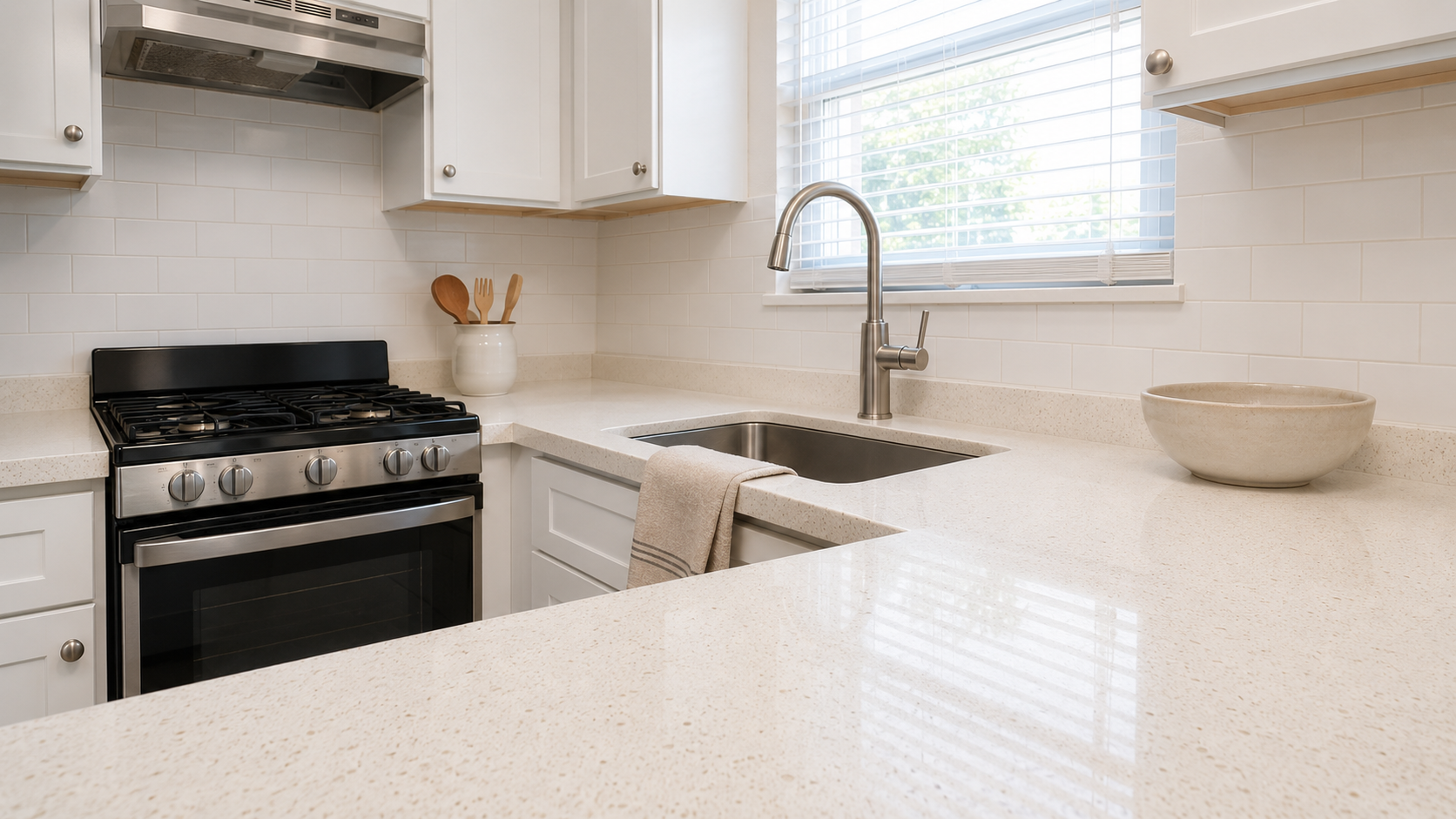
Color and pattern choice matters more in a rental than most owners expect. The best rental countertop color is neutral. It photographs well for a listing, reads clean in person and doesn’t compete with whatever furniture the next tenant brings in.
Busy, high-contrast patterns can look striking on a showroom slab, but they can make a small kitchen feel cluttered or dated fast. Neutral doesn’t have to mean plain. Soft grays, warm whites and subtle veining give you visual interest without locking the kitchen into one style.
A few practical guidelines:
- Favor consistent movement over dramatic veining. Subtle, repeatable patterns are easier to photograph and easier to match if a section ever needs repair.
- Choose colors that pair with multiple cabinet finishes. You may update cabinets or flooring before the countertop ages out.
- Think about resale, not just the current tenant. Broad appeal protects the property’s value if you eventually sell rather than rent it again.
Plan for Scratches, Heat, Stains and Chips
Every countertop material has a weak point. Knowing it ahead of time lets you set expectations and give tenants simple care guidance. Our guide on countertops designed for busy kitchens covers how these same materials hold up under heavy daily use, useful context for a high-traffic rental.
- Quartz: Resists stains well, but is vulnerable to direct high heat and can scratch under enough pressure. See how quartz handles scratches in daily use.
- Granite: Handles heat and daily scratches well, but needs sealing on a schedule to keep stain resistance intact.
- Compact surfaces: Strong across heat, scratches and stains, with performance tied closely to fabrication and edge quality.
- Chips: Any material can chip at an edge or corner under a hard impact. This is a fabrication and edge-profile question as much as a material question.
No material is damage-proof, and no rental countertop should be marketed as indestructible. What matters is knowing a material’s real weak points and using them to guide simple care instructions.
Use and care habits vary from one tenant to the next, and that’s normal in any rental property. The goal isn’t a perfect surface. It’s a surface that holds up well under variable use and is easy to check between tenants.
Keep Edge Profiles and Extras Practical
The edge profile on a rental countertop affects durability, cost and how easy it is to repair later. A simple eased or bullnose edge fits most rental kitchens and holds up well without drawing attention to itself.
More elaborate edges can look impressive in a showroom, but they add cost and sometimes create thinner points that chip more easily under daily use. Before you approve an upgrade, ask whether it matches the rent level and how the kitchen will actually be used.
The same question applies to sink cutouts and overhang support. A well-supported overhang for stools can add real value in the right property. An oversized or unsupported overhang in a lower-tier rental is a maintenance risk without a matching return. Match the extras to the property, not to what looks best in a photo.
Use the Turnover Window Wisely
Tenant turnover is often the best, and sometimes the only practical, window to complete a countertop project without disrupting an occupied unit. Using that window well starts with the job site.
Before a Design Consultant can schedule your measure, the space needs to be ready. That means old countertops removed if applicable, utilities accessible and the area clear for accurate templating. A ready job site keeps the project moving and avoids delays that turn a simple turnover into a longer vacancy.
Material availability matters too. When your selection is in stock and the job site is ready, Edge Collection™ projects can move through fabrication and installation quickly. That’s not a guarantee for every project or material, but it’s a real edge of working with a fabricator who carries live inventory instead of special-ordering every slab. A dedicated project coordinator keeps the schedule organized on our end, which matters most against a lease start date.
Build a Simple Between-Tenant Care Routine
A repeatable care routine protects your investment without demanding constant attention while the unit is occupied. Build it into your existing turnover checklist.
- Inspect the full surface. Look for chips, cracks, stains or seam separation while the kitchen is empty and easy to see.
- Clean with the right products. Avoid harsh abrasives or acidic cleaners that can dull the finish or damage natural stone. For a full rundown, see our guide on countertop cleaning mistakes to avoid.
- Reseal natural stone as needed. If you installed granite, check the seal and reapply on schedule rather than waiting for a stain to prompt it.
- Document the condition. A few photos at each turnover give you a record if a repair or replacement conversation comes up later.
This routine takes an hour or less per turnover, and it gives you an early read on issues before they become a bigger repair.
Choose a Surface That Reduces Avoidable Work
The best rental countertop isn’t the flashiest one. It’s the one that creates the fewest avoidable problems for your property, tenants and timeline. That means matching material, color and edge profile to the property tier instead of defaulting to the priciest option.
If you’re planning a rental kitchen update, bring your measurements, photos, budget and turnover date to a Design Consultant who can walk you through the options for your project. View live inventory at a showroom near you across Ohio, Michigan and Indiana, or schedule a conversation with a Design Consultant to get started before your next turnover date.
FAQs About Rental Property Countertops
What is the best countertop for a rental property?
It depends on the property tier and how the kitchen gets used. Quartz is a strong all-around fit for many rentals since it doesn’t need sealing and resists stains well. Granite suits higher-tier properties where natural stone matches the finish level, and compact surfaces fit higher-use or design-forward spaces.
Is quartz worth the cost in a rental kitchen?
For many rentals, yes. Quartz combines stain resistance, a consistent look and no sealing requirement, which cuts down on maintenance between tenants. It still needs basic care, like using a cutting board and avoiding direct high heat.
Should I install granite in a rental property?
Granite can be a strong choice for a higher-tier rental, but it requires sealing on a schedule to maintain stain resistance. If you’re comfortable managing that maintenance between tenants, granite offers good heat and scratch performance.
What countertop color works best for rentals?
Neutral colors with subtle, consistent pattern movement tend to work best. They photograph well for listings, pair with a range of cabinet finishes and hold broad appeal for tenants or a future buyer.
How should rental countertops be maintained between tenants?
Inspect the full surface for chips, stains or seam issues, clean with non-abrasive products suited to the material, reseal natural stone if needed and document the condition with photos. Building this into your existing turnover checklist keeps it simple.